
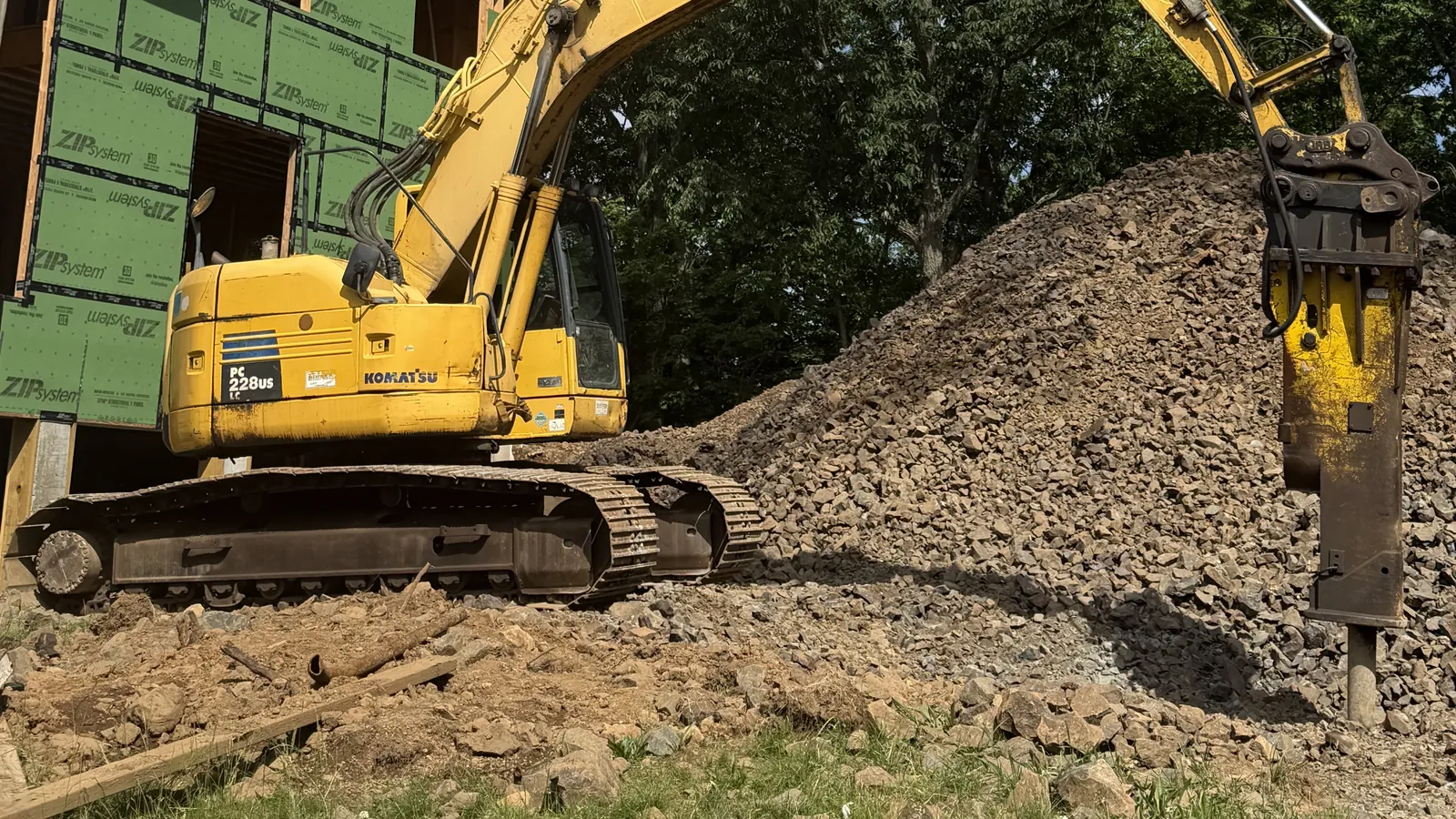
How Much Does Excavation Cost in New Jersey?
Excavation alone runs $75 to $150 per cubic yard of dirt, by one 2026 national home guide. That guide figures a 1,000 square foot basement at about 300 cubic yards, or $22,500 to $45,000. A second national cost guide puts basement excavation at $10 to $20 per square foot. Rock and groundwater add work wherever a New Jersey dig meets them.
Those are market numbers, not our price list. TTL Services digs foundations and basements after a teardown or on a lot that is already clear. Our excavation page covers how that work runs across North Jersey.
What do national cost guides say excavation costs?
The table pulls published ranges from two national guides. The first is a 2026 guide to digging out basements. The second covers clearing and preparing a building lot, and it was updated in 2025.
| What gets priced | Published range | Guide |
|---|---|---|
| Excavation alone, per cubic yard of dirt | $75 to $150 | 2026 basement guide |
| Basement excavation, per square foot | $10 to $20 | 2025 site guide |
| Land excavation, per square foot | $6 to $43 | 2025 site guide |
| Site work, per square foot | $2 to $10 | 2025 site guide |
| Soil testing, per acre | $700 to $1,800 | 2025 site guide |
| Permits, each | $150 to $1,500 | 2025 site guide |
| A basement dug out under a standing house | $50,000 to $150,000 or more | 2026 basement guide |
The two guides land far apart on a basement because they measure it differently. A cubic yard price follows the dirt. A square foot price follows the floor plan and leaves out how deep the hole goes. So ask every quote to show the cubic yards it assumes.
What moves the price of an excavation?
Size and depth come first. A deeper hole moves more dirt, and federal safety rules make it wider too. Workers in any excavation 5 feet deep or more need a protective system, unless the cut is in stable rock.
Without soil data or an engineer’s design, the rule sets the slope. The sides go back at least one and a half feet for every foot down. That slope adds cubic yards. Where a lot has no room to slope, shoring or a trench box does the job instead.
Where the dirt goes is the next line. Every cubic yard that leaves rides a truck to a place that will take it. Federal rules keep dug dirt at least 2 feet back from the edge of the hole. A tight city lot has little room to pile it, so more of it trucks out as the dig goes.
Access matters as well. When a dig puts the building next door at risk, federal rules call for support, such as shoring or underpinning.
How does North Jersey ground change the cost?
The national soil survey maps Boonton soils on till uplands in northeastern New Jersey, and its type location for the series is in Totowa, in Passaic County. They formed in till on uplands, the ground the glaciers left. They also hold a perched water table from November to May in most years. It sits 46 to 91 centimeters down, about 18 to 36 inches.
Water in the hole slows the work. A basement dug in late winter or spring can need pumping before the builder’s footings go in. Federal rules also call for a fresh inspection of an open excavation after every rainstorm.
Rock is the other wild card. Holyoke soils sit on bedrock controlled ridges and hills in northeastern New Jersey, and they reach hard bedrock at 25 to 50 centimeters. That bedrock is mostly basalt. At the Great Falls, the National Park Service describes the dark basalt gorge of the Passaic.
A dig that meets basalt takes heavier work than one in till. The 2025 site guide prices soil testing at $700 to $1,800 per acre. A test before the dig can show what the hole will meet.
What is left in the ground after a teardown?
A lot where a building just came down has its own costs. The old basement walls and floor slab can still sit in the ground. Those come out before the new hole goes in, and the concrete goes to recycling.
Sometimes we take a building down and then dig for the next foundation on the same lot. Our house demolition page covers the teardown side. Our guide to house demolition cost in New Jersey covers what that part of the job costs.
What permits and rules come with a dig in New Jersey?
Every dig starts with a call. New Jersey One Call tells anyone digging to call at least three full business days before work starts. Weekends and holidays do not count, and the number is 811. When a homeowner hires a contractor, One Call puts the responsibility on the contractor to call for the dig ticket.
Bigger sites need a soil erosion plan. The state’s soil erosion law covers all construction activities greater than 5,000 square feet. Its definition counts ground disturbed for the demolition of one or more structures. The county soil conservation district reviews the plan and has 30 days from a complete application to decide.
The town will not issue a certificate of occupancy for the new building until that plan has been followed. Large commercial sites add the state’s stormwater rules. Those rules treat the disturbance of one or more acres of land as major development. The owner’s engineer designs to them.
The town’s construction office answers what a given dig needs, and we point you there. For the paperwork behind a teardown, see our guide to demolition permits in New Jersey.
What about digging a basement under a house that stays?
That is a different job from ours. Digging under a standing house means underpinning its foundation. The 2026 basement guide says the job needs a structural engineer.
That guide puts underpinning alone at up to $20,000. It puts the whole dig-out at $50,000 to $150,000 or more. That work belongs to a structural specialist.
How should you compare excavation quotes?
Set the quotes side by side and read them line by line. Look for the cubic yards each one assumes and where the dirt goes. Ask whether old foundations, rock, water and trench protection sit inside the number.
A quote that skips the old slab prices a smaller job. We look at the lot and the plans, then put the quote in writing.
Ready to price your dig?
National ranges show the size of the bill. The lot and the plans set the real number. Our excavation contractor page covers foundation digs and trenching across North Jersey.
When the lot needs clearing and grading first, see site preparation and grading. The 2025 site guide puts clearing a lot to build at $2,500 to $5,000 on average. Call or text (973) 899-3366, and we will look at the job and put the quote in writing.