
Tear Down or Renovate a House in New Jersey?
Renovate when the frame and foundation are sound and you can live with the layout. Tear down and rebuild when the structure is failing, or when the fixes would replace most of the house. One national cost guide puts a whole-house remodel at $15 to $60 per square foot. A teardown and rebuild runs $104 to $165.
New Jersey’s rehab code and flood rules can tip the choice, and so can local zoning.
TTL Services is a demolition contractor in Paterson. When an owner or builder chooses to rebuild, we handle the house demolition. The renovation is a general contractor’s job, and the new house is the builder’s. This guide is general information, not legal advice.
When does a teardown and rebuild make more sense?
One national cost guide lists the signs that favor demolition:
- The foundation has structural problems.
- Ceilings are too low, sagging or badly cracked.
- Severe mold or pest damage has reached the structure.
- The house is older than 50 to 70 years, with many wiring and plumbing problems.
Age is the common one here. The typical New Jersey home was built in 1970, and about half were built before then, by Census Bureau counts. In a flood zone, the 50 percent line covered below can also tip the choice toward building new.
When does renovating make more sense?
Renovate when the structure is sound and the problems sit in the finishes and systems. The same national guide calls a whole-house remodel the faster path. You keep the frame, the foundation and the house’s place on the lot.
New Jersey’s code once held a building to new-building rules when rehab cost over 50 percent of its replacement cost. The Rehabilitation Subcode dropped that test. Its guide says the rules depend on the type of work, not its extent. Any existing work may be repaired.
How does New Jersey’s Rehabilitation Subcode sort the work?
The subcode, N.J.A.C. 5:23-6, sorts work on an existing building into six categories. They are repair, renovation, alteration, reconstruction, change of use and additions. One project can mix several.
- Repair restores worn or broken parts with the same or closely similar materials.
- Renovation swaps finishes, trim, doors or windows for new ones that serve the same purpose, with the layout unchanged.
- Alteration changes the layout or the systems, such as new walls, a new ceiling height or an added window.
- An addition grows the footprint or the height.
- A change of use puts the building to a different use.
Reconstruction is not a kind of work. It depends on the extent and nature of the project. A project becomes one when the work area cannot be occupied during the work. The area must also need a new certificate of occupancy before anyone moves back in. Both must be true, and the code sets no numbers test. The town’s construction office can say where your plans fall.
What is the 50 percent rule for a house in a flood zone?
The federal flood insurance program draws two lines in 44 CFR 59.1. A substantial improvement is any reconstruction, rehab or other improvement costing 50 percent or more of the structure’s market value. That value is measured before the work starts. Substantial damage is damage of any origin that would cost that much to restore, using the value before the damage.
New Jersey’s Rehabilitation Subcode builds on those lines. In a designated flood hazard area, work that counts as either one must meet flood-resistant construction requirements. The local floodplain administrator makes that call for a given house.
The federal definition leaves out work that only fixes code violations a local official has cited. Some work on historic buildings is left out too. Ask the floodplain administrator before you price either path.
Can you rebuild a nonconforming house in New Jersey?
A nonconforming house was there before a zoning rule it does not meet. Under N.J.S.A. 40:55D-68, it may stay, and it “may be restored or repaired in the event of partial destruction”.
That protection is written for restoring or repairing. What a brand-new house on the lot has to meet is the zoning officer’s call for that lot, so ask before the old house comes down.
What do older New Jersey houses hide?
Lead paint comes first. The federal government banned the sale of lead-based paint for homes in 1978. EPA says about three-quarters of U.S. homes built before 1978 still contain some. Under EPA’s Renovation, Repair and Painting Rule, anyone paid to disturb paint in those homes must hold certification. Their workers need lead-safe training.
Asbestos is the other one. Our guide to asbestos inspection before demolition covers the survey, the notices and who removes it. A national renovation guide adds structural surprises and outdated wiring or plumbing to the common hidden costs.
What does a teardown involve in New Jersey?
A demolition needs a permit from the town’s construction official, the same office that issues renovation permits. The permit waits on releases from every utility that served the house. One New Jersey utility, Public Service Electric and Gas, says its letter can take up to eight weeks. The permit also waits on the asbestos step. Our asbestos abatement and demolition service puts both jobs under one contract.
If a teardown and rebuild disturbs 5,000 square feet or more of ground, it needs soil erosion certification. The soil districts’ 2026 manual says that covers both the demolition and the new home’s construction. Our guide to the demolition permit in New Jersey covers the paperwork.
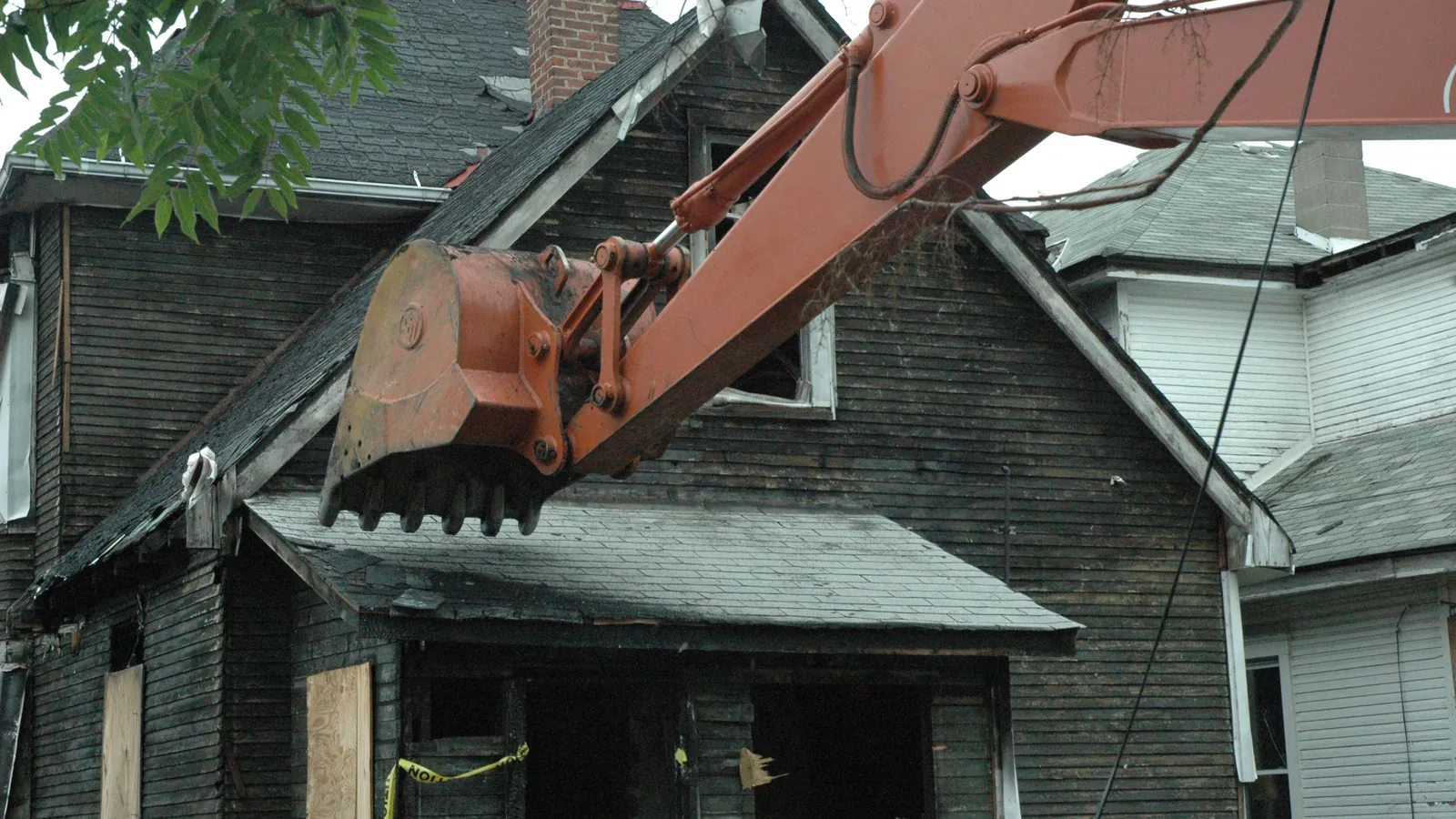
The machine work comes last, and one national guide puts it at 2 to 5 days on average. We take the house down, haul the debris, then handle the excavation and site preparation. The builder’s concrete contractor pours the new foundation in the hole we dig.
How do renovation and rebuild costs compare?
National cost guides price both paths by the square foot. These are market numbers, not our price list.
The $15 to $60 and $104 to $165 figures at the top come from one guide’s comparison table. A second national guide runs renovations from $15 per square foot for basic updates to $150 for high-end work. The teardown’s own share is in our house demolition cost guide.
| Renovate | Tear down and rebuild | |
|---|---|---|
| What it keeps | The frame, the foundation and any zoning protection the old house has | The lot; the old house and its foundation come out |
| What it triggers | A construction permit; lead rules in a house built before 1978; flood rules past the 50 percent line | A demolition permit, utility releases and the asbestos step; soil erosion certification at 5,000 square feet or more; a zoning check for the new house |
| What drives the cost | Finish level, structural surprises, old wiring and plumbing | The new house’s size, plus the teardown, haul-off and dig |
| How long | Faster, in one national guide; a reconstruction means moving out | Weeks of permits and utility letters, days of teardown, then the builder’s schedule |
| Who does the work | A general contractor | A demolition contractor, then the builder |
Ready to take the house down?
If the numbers point to a rebuild, the first job is a clean teardown. Our house demolition page covers how we take down whole houses across New Jersey. Call or text (973) 899-3366, and we will look at the job and put the quote in writing.